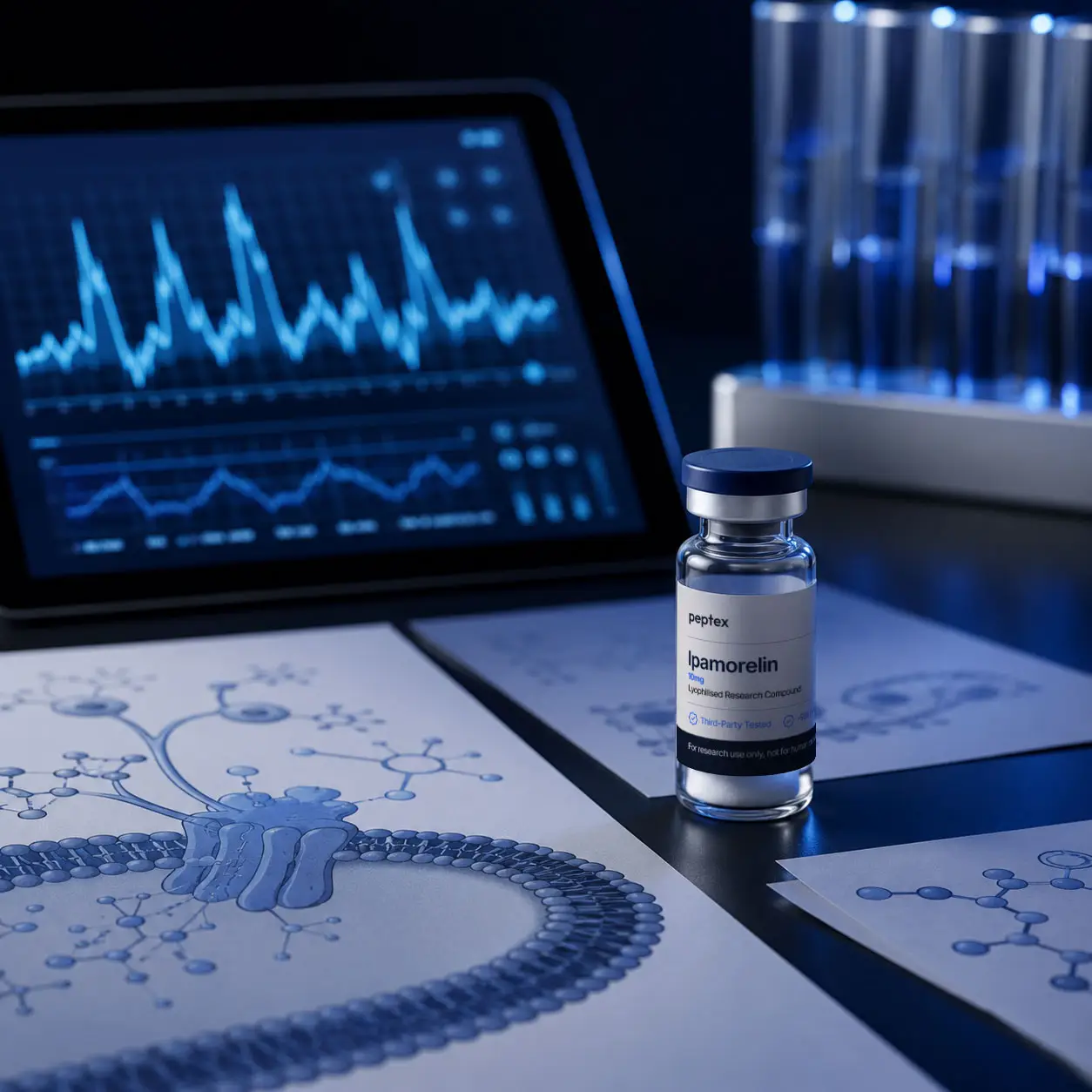
A Peptex research update on ipamorelin, exploring selective growth hormone secretagogues, ghrelin receptor signalling, endocrine pathway research and why receptor selectivity remains important in peptide studies.
Ipamorelin is one of the more interesting peptides in the growth hormone secretagogue research space. Unlike some earlier growth hormone-releasing peptides, ipamorelin has been studied for its selective activity at the growth hormone secretagogue receptor, also known as the ghrelin receptor.
That selectivity is what makes ipamorelin stand out. Rather than simply being grouped with older GHRP compounds, ipamorelin is often discussed as a more targeted model for studying growth hormone release, ghrelin receptor signalling and endocrine pathway regulation.
Recent peptide research has continued to revisit growth hormone secretagogues, ghrelin biology and the wider role of peptide signalling in ageing, metabolism and tissue-related research. While ipamorelin itself is not a newly discovered compound, it remains relevant because it sits at the centre of several important research themes.
What Is Ipamorelin?
Ipamorelin is a synthetic pentapeptide and growth hormone secretagogue. It was originally developed as a selective ghrelin receptor agonist designed to stimulate growth hormone release in research models.
The original pharmacology research described ipamorelin as a compound with strong growth hormone-releasing activity and a high degree of selectivity compared with earlier growth hormone-releasing peptides.
This selectivity is the reason ipamorelin is still discussed in research settings. It provides a useful model for studying how growth hormone secretagogue receptor activation may influence endocrine signalling without the same level of broader off-target pathway activity associated with some earlier compounds.
Why Ipamorelin Is Still Relevant in Peptide Research
Research interest around ipamorelin is not only about growth hormone release. It is also about receptor selectivity.
Earlier growth hormone-releasing peptides helped researchers explore the relationship between peptide structure and endocrine signalling. However, some of those compounds were associated with broader effects across related endocrine pathways.
Ipamorelin became notable because it was investigated as a more selective growth hormone secretagogue. That makes it useful when researchers want to examine ghrelin receptor-linked growth hormone signalling with fewer overlapping variables.
The Ghrelin Receptor Connection
The ghrelin receptor, also known as GHSR1a, plays an important role in growth hormone release and broader biological signalling. Ghrelin itself is often simplified as a hunger hormone, but current research views it as much more than that.
Modern ghrelin research looks at its role across metabolism, appetite regulation, gastrointestinal signalling, neuroendocrine function and systemic physiology. This wider view has made ghrelin receptor agonists an important area of peptide research.
Ipamorelin fits into this space because it acts through the growth hormone secretagogue receptor pathway. This makes it relevant to studies looking at how synthetic peptide ligands can influence ghrelin-linked signalling systems.
Recent Research Interest Around Growth Hormone-Releasing Peptides
Recent work has continued to examine growth hormone-releasing peptides as a class, including how their structure may influence their biological behaviour.
One recent study investigated several GHRPs using electronic circular dichroism spectroscopy, a technique used to examine peptide structure. The study also looked at how selected compounds interacted with model membrane systems.
This type of research matters because peptide activity is not only determined by a compound’s amino acid sequence. Shape, structure, membrane interaction and receptor binding behaviour can all influence how a peptide behaves in a laboratory model.
For ipamorelin and related GHRPs, this helps explain why researchers continue to study structural differences within the class rather than treating all growth hormone secretagogues as interchangeable.
Ipamorelin and Endocrine Selectivity
One of the main reasons ipamorelin receives attention is its reported endocrine selectivity.
Foundational research described ipamorelin as a potent growth hormone secretagogue with selectivity for growth hormone release. Later reviews have also discussed growth hormone secretagogues as compounds that may promote pulsatile growth hormone release through ghrelin receptor-related mechanisms.
For researchers, this raises useful questions:
- How does ghrelin receptor activation influence growth hormone signalling?
- How does ipamorelin compare with earlier GHRP compounds?
- What structural features contribute to receptor selectivity?
- How do synthetic ghrelin mimetics differ from endogenous ghrelin?
- What are the limitations of translating early research models into wider conclusions?
How Ipamorelin Differs From Earlier GHRPs
Earlier growth hormone-releasing peptides, such as GHRP-2 and GHRP-6, are often discussed in relation to growth hormone release, appetite signalling and broader endocrine activity.
Ipamorelin is different because it has been studied as a more selective ghrelin receptor agonist. This makes it an important comparison compound in research focused on selectivity, receptor targeting and endocrine pathway separation.
That does not mean ipamorelin is fully understood. Instead, it means it provides a cleaner research model than some earlier compounds when studying specific aspects of growth hormone secretagogue receptor signalling.
Research Areas Connected to Ipamorelin
Ipamorelin research connects with several wider areas of peptide science, including:
- Growth hormone secretagogue receptor signalling
- Ghrelin receptor agonist research
- Endocrine pathway selectivity
- Pulsatile growth hormone release models
- Peptide structure and receptor interaction
- Metabolic and age-related signalling research
- Comparative studies between different GHRP compounds
This makes ipamorelin useful as part of a broader research discussion, especially when looking at how peptide design can influence receptor targeting.
Why Researchers Are Watching Ghrelin Signalling
Ghrelin biology has become more complex than early descriptions suggested. Current research describes ghrelin as a hormone involved in several systems, not just appetite.
Because of this, synthetic ghrelin receptor ligands are useful tools for studying how this receptor system behaves under controlled conditions.
Ipamorelin is one of the compounds often discussed in this context because of its selectivity profile. It gives researchers a way to explore growth hormone secretagogue receptor signalling without treating all ghrelin mimetics as identical.
Important Research Limitations
Although ipamorelin is widely discussed in peptide research, it is important to keep the evidence in context.
Much of the foundational research comes from early pharmacology, preclinical models or controlled experimental settings. These findings should not be treated as instructions for human use, self-experimentation or non-clinical application.
Research into growth hormone secretagogues also requires caution because endocrine signalling is complex. Growth hormone, IGF-1, ghrelin, appetite regulation, glucose handling and tissue signalling are all interconnected.
For that reason, ipamorelin should be discussed as a laboratory research compound and receptor-signalling model, not as a wellness, fitness or anti-ageing product.
What This Means for Peptide Research
Ipamorelin remains interesting because it represents a more selective branch of growth hormone secretagogue research.
The bigger story is not simply that ipamorelin may influence growth hormone release in study models. The more useful research angle is how selective peptide design can help scientists investigate specific receptor pathways with fewer overlapping effects.
As peptide research continues to move toward more precise receptor targeting, compounds like ipamorelin remain relevant for understanding the relationship between peptide structure, receptor selectivity and endocrine signalling.
Research Use Only Notice
This article is provided for educational and research reference purposes only. Peptex products and research materials are supplied strictly for laboratory research use only. They are not intended for human consumption, medical use, diagnostic use, therapeutic use or veterinary use.
Nothing in this article should be interpreted as medical advice, treatment guidance or a recommendation for use. All research materials should only be handled by suitably qualified professionals in appropriate laboratory settings.
References
- Raun K et al. “Ipamorelin, the first selective growth hormone secretagogue.” European Journal of Endocrinology, 1998.
- Králík F et al. “Growth Hormone-Releasing Peptides: Investigation of Their Structure and Interaction with Model Membranes.” 2026.
- Polishchuk H et al. “The Structure, Signaling, and Systemic Roles of Ghrelin.” 2025.
- Sigalos JT et al. “The Safety and Efficacy of Growth Hormone Secretagogues.” 2017.