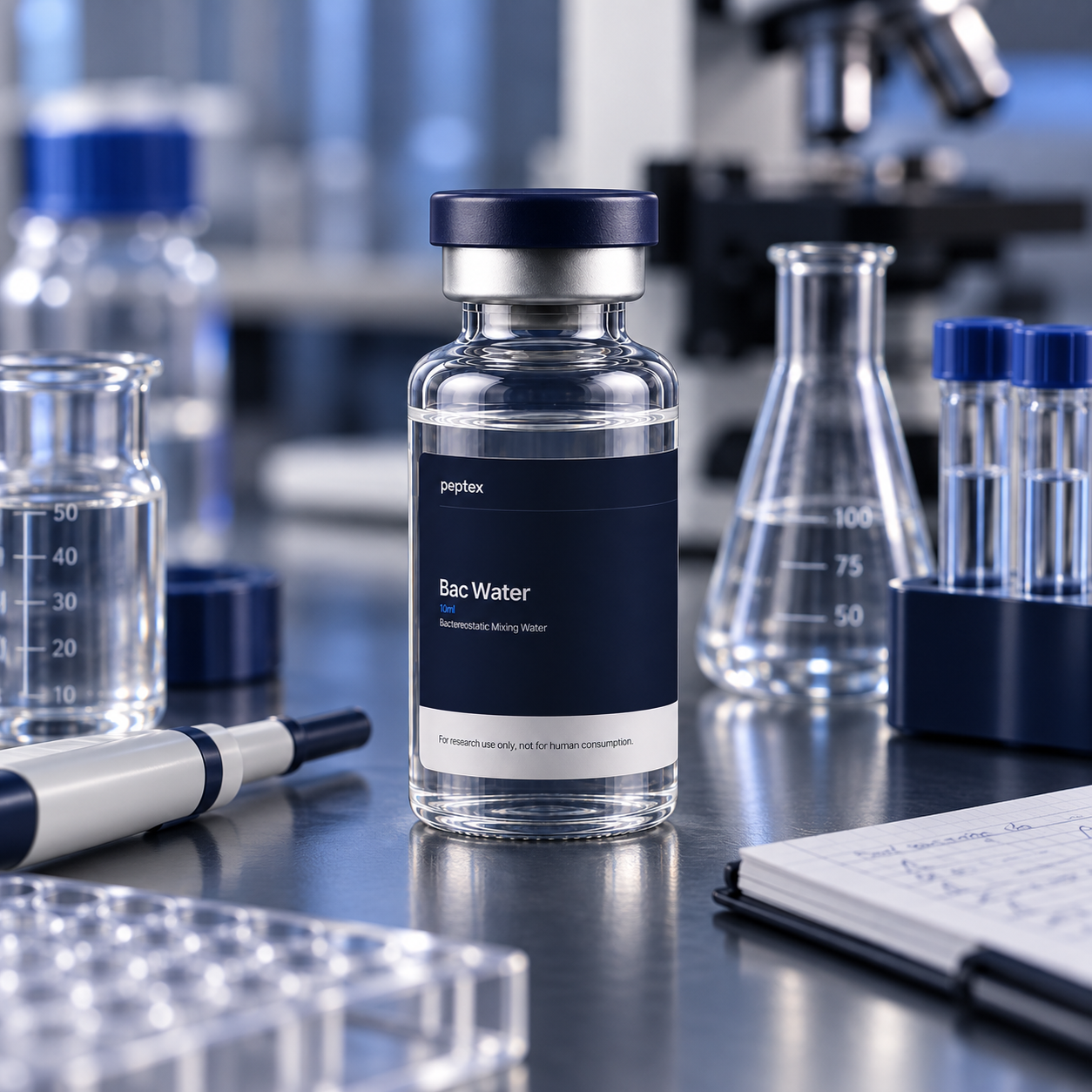
A Peptex research guide to bacteriostatic water, commonly known as Bac Water, exploring its purpose, composition, laboratory relevance and why sterile handling matters in peptide research settings.
Bac Water, short for bacteriostatic water, is one of the most commonly discussed sterile solutions in peptide research and laboratory preparation. It is often referenced alongside research peptides because it is used as a sterile diluent in controlled research environments.
Although the term is widely used, Bac Water is often misunderstood. It is not simply ordinary water, and it is not the same as sterile water without preservatives. Its key feature is the presence of a bacteriostatic agent, usually benzyl alcohol, which helps inhibit the growth of certain bacteria after the vial has been opened.
For researchers, understanding what Bac Water is, how it differs from other sterile solutions and why handling protocols matter is important for maintaining consistency, cleanliness and reliable research conditions.
What Is Bac Water?
Bac Water is bacteriostatic water for injection. It is sterile water that contains a small amount of benzyl alcohol, most commonly 0.9%, as a preservative.
The word “bacteriostatic” means that the solution is designed to inhibit bacterial growth. This does not mean it sterilises contaminated materials, and it does not replace proper aseptic handling. Instead, the preservative helps reduce the risk of bacterial proliferation in the solution after the vial has been accessed.
In laboratory and research settings, Bac Water is commonly used where a sterile diluent is required for research materials that are supplied in a dry or lyophilised form.
Why Bac Water Is Used in Peptide Research
Many research peptides are supplied as lyophilised powder. This freeze-dried format can help support stability during storage and transport, but the material often needs to be dissolved into a suitable liquid before it can be used in a controlled research protocol.
Bac Water is commonly selected because it provides a sterile aqueous diluent with preservative properties. This makes it useful in research environments where sterility, consistency and careful sample handling are important.
Its role is practical rather than active. Bac Water does not contribute to the biological mechanism of a peptide or research compound. Instead, it acts as a preparation medium, helping researchers create a solution from a dry research material.
Bac Water vs Sterile Water
Bac Water and sterile water are not the same.
Sterile water is water that has been sterilised but typically does not contain a preservative. Once opened, it is generally intended for single-use handling because there is no bacteriostatic agent present to inhibit bacterial growth.
Bac Water contains benzyl alcohol, which gives it bacteriostatic properties. This is the main reason it is often discussed in relation to multi-access research preparation, although correct sterile technique and appropriate laboratory controls remain essential.
The difference matters because using the wrong diluent can affect protocol consistency, handling expectations and storage decisions.
Common Research Uses of Bac Water
In research and laboratory contexts, Bac Water may be used as a sterile diluent for lyophilised research compounds, including certain peptide materials.
Common research-related uses include:
- Reconstituting lyophilised research peptides
- Preparing controlled laboratory solutions
- Supporting consistency in research sample preparation
- Acting as a sterile diluent in non-clinical research workflows
- Helping maintain solution integrity when handled according to appropriate protocols
The exact suitability of Bac Water depends on the material being studied, the research protocol and the required laboratory conditions.
Why Benzyl Alcohol Matters
The preservative in Bac Water is usually benzyl alcohol. Its role is to inhibit the growth of certain microorganisms after the vial has been opened.
This preservative function is what separates Bac Water from plain sterile water. However, it is important to understand its limitation. Benzyl alcohol does not make poor handling safe, and it does not protect against every contamination risk.
Researchers should still follow strict aseptic technique, use appropriate sterile equipment and work within suitable laboratory conditions.
Storage and Handling Considerations
Bac Water should be handled carefully to preserve sterility and consistency. Storage conditions should follow the manufacturer’s label and any applicable laboratory protocols.
Key handling considerations include:
- Keeping the vial sealed until required
- Avoiding contact between sterile and non-sterile surfaces
- Using appropriate sterile equipment
- Labelling prepared materials clearly
- Following internal research protocols for storage and disposal
- Avoiding use if the solution appears cloudy, discoloured or compromised
Good handling practice is essential because contamination can affect research reliability and safety.
Why Bac Water Quality Matters
The quality of the diluent used in research preparation can influence the consistency of a study. If a diluent is unsuitable, contaminated or handled incorrectly, it may compromise the preparation and make results less reliable.
For peptide research, where accurate preparation and controlled conditions are important, researchers typically look for sterile, clearly labelled materials from trusted suppliers.
Bac Water should be treated as part of the wider research workflow, not as an afterthought. Proper documentation, storage and handling all contribute to better laboratory practice.
Bac Water and Peptide Stability
Bac Water is often discussed in relation to peptide stability, but it is important to avoid overgeneralising. Different peptides can have different stability profiles once reconstituted.
Factors that may affect stability include:
- Peptide sequence and structure
- Diluent compatibility
- Concentration
- Temperature
- Light exposure
- Storage time
- Handling conditions
Because of this, researchers should always refer to compound-specific documentation, supplier guidance and the requirements of their own study protocol.
Important Limitations
Bac Water is not suitable for every compound, every protocol or every research setting. Some materials may require a different solvent, buffer or preparation method.
It should also not be assumed that bacteriostatic properties remove the need for sterile technique. Bac Water can help inhibit bacterial growth, but it cannot correct contamination introduced through poor handling.
For this reason, Bac Water should only be used by trained professionals in appropriate research or laboratory environments.
Why Bac Water Is Widely Discussed
Bac Water is widely discussed because it sits at the practical centre of many peptide research workflows. While peptides and research compounds often receive most of the attention, the diluent used to prepare them is also important.
A suitable diluent helps support consistency, preparation control and cleaner handling. In research environments where repeatability matters, these details can have a meaningful impact.
Bac Water is not complex in concept, but it plays an important supporting role in laboratory preparation.
Research Use Only Notice
This article is provided for educational and research reference purposes only. Peptex products and research materials are supplied strictly for laboratory research use only. They are not intended for human consumption, medical use, diagnostic use, therapeutic use or veterinary use.
Nothing in this article should be interpreted as medical advice, treatment guidance or a recommendation for use. All research materials should only be handled by suitably qualified professionals in appropriate laboratory settings.